
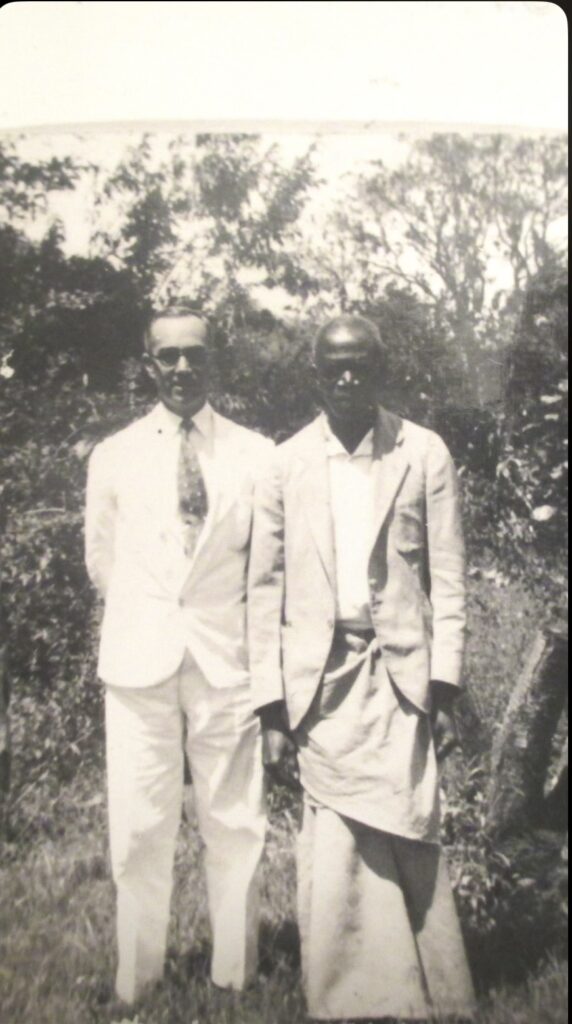
Ralph Collins: 1892-1970; Jean Collins: 1903-1994. Born in 1892 in Winterslow, Wiltshire, England, Ralph Collins emigrated to Ottawa, Canada in 1912 with his parents and siblings. He worked for years before he, as could be done then, wrote the Senior Matriculation examinations for Ontario (Grade 13) without ever having attended a high school. One could do this for the exorbitant fee, for the time, of $10. At McGill University, Montreal, he completed a B.A. and B.Div. After ordination, he was appointed to Angola in 1925, and was posted to Camundongo, Bié Province, that station then being run by Rev. Dr. William Sanders, who together with Pastor Samose initiated Ralph in his new duties. Ralph was devoted to both and often spoke of how much Sekulu Samose had taught him, including much Umbundu, although he did not appreciate it when Samose would interrupt him from the floor during a sermon, to correct his Umbundu. Three and a half years later he returned to Canada on furlough – and to marry Jean Gurd.
Jean Collins, née Gurd, was born in 1903 in Montreal. She took her B.A. at McGill University, honouring in English literature and receiving the Shakespeare Gold Medal. She was valedictorian of her class, had been President of the Women’s Undergraduate Society, and was instrumental in bringing into being the McGill Women Students’ Society. She was also a debater for McGill in the intercollegiate debates, winning against Queens University and University of Toronto. A passionate member and then leader of the Canadian Girls In Training (CGIT), Jean gained early experience in leadership training. In 1926 she was granted her M.A. in English and joined the staff of the English Department of McGill where she taught until 1929 when she married Ralph Collins and went with him to Angola, where they served together until 1958.
Ralph and Jean had met while both at McGill and attending Emmanuel Congregational Church (before church union). Jean’s parents hosted the McGill theology students in their home every Sunday evening, and Jean and Ralph became friends. During Ralph’s first three years in Angola, they corresponded, and one day Ralph proposed, by telegram, asking Jean to respond with just one word: Yes, or No. She responded “Yes.” When Ralph returned on furlough they were married in Montreal in June 1929 by Dr. T. W. Jones, who later became a Moderator of The United Church of Canada. They went together to Angola in the fall of that year, and immersed themselves in the work in Camundongo. Ralph was already becoming fluent in Portuguese and Umbundu. Jean, of course, did not have the chance to study Portuguese in Portugal, and Ralph taught her some Portuguese on the weeks-long ship journey to Angola! In Angola, she too, as had Ralph, studied Umbundu under an Umbundu elder, and soon became fluent.
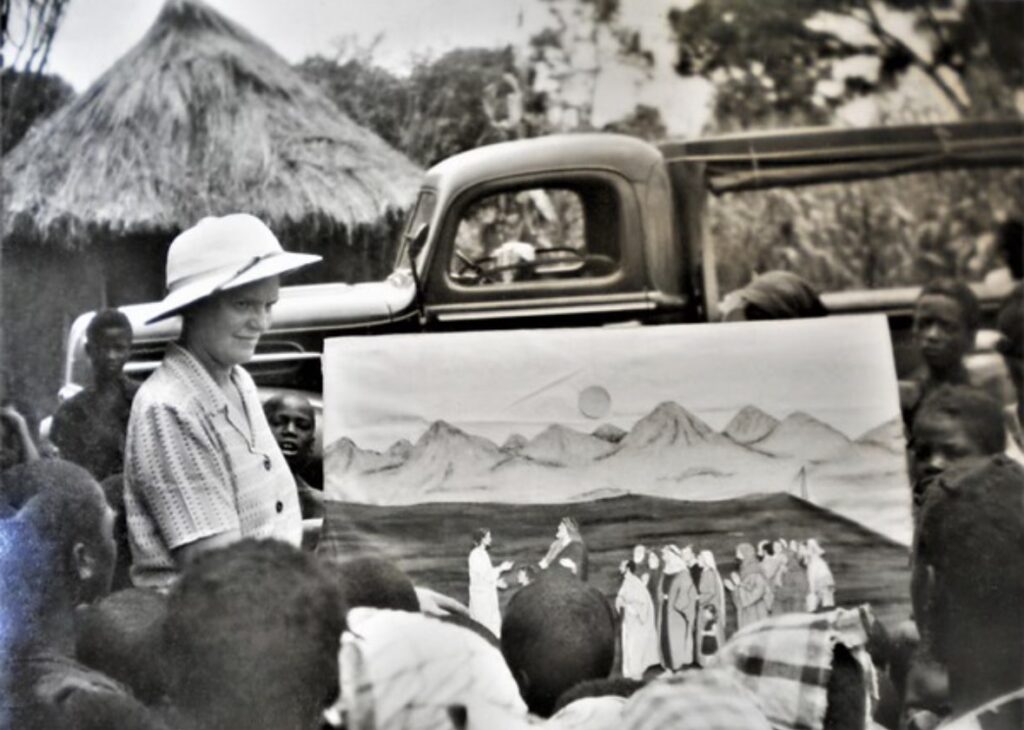
Jean immediately became involved in the work of the church in Camundongo, taking on a wide variety of responsibilities. After she had been there only a short time, Ralph told her she should start working. What can I do, without enough language yet? she asked. You could teach sewing, he replied! – and taught her two phrases: “Linga ndomo” (Do it like this), and “Tongolola” (Rip it out)! She taught sewing to sixth-grade girls. From 1929 to 1946 she had charge of a kindergarten of some 100 children and three teachers, principally teaching and training the teachers, but also enjoying time with the children every day, later delighting many with stories of her interactions with them. She was given charge of the work among women in the whole area which consisted of 200 villages, working through the Angolan women leaders, deaconesses and local village leaders. She organized training sessions for women leaders, Sunday School teachers and village catechists. Camps and conferences for women leaders and short-term schools were all part of the training programs. In addition to the women’s camps and conferences she participated in, together with Ralph she made many trips to the villages, where they camped and spent a few days. In the very early years they sometimes traveled by “bushcar”, a kind of armchair sitting over a big, single wheel, with arms protruding front and back. These were grasped and steadied by a bearer, front and back, who then literally “wheeled” them to their destination. Ralph usually walked, and old photographs show him in a white suit and tie, even in that heat!, and always a pith helmet on his head. They were eighteen years in Camundongo (with a brief stint in Chissamba), and after some years Ralph was appointed Mission Director.
As the years unfolded, and always working full time, Jean and Ralph raised their four children, three of whom were born in Angola, the oldest having come with them after a furlough at the age of only a few months.
Not long after their third child was born (1941), the family travelled to South Africa for a few months’ holiday and also to seek treatment for Ralph who was suffering terribly from a duodenal ulcer. Back in Camundongo, Ralph continued to suffer severely until, with the war’s end, they could return to Canada, spending part of 1946 and 1947 in Ottawa primarily. Ralph was operated on, in Montreal, by Jean’s older brother and distinguished Montreal surgeon, Dr. Fraser Gurd. Both he, and his equally distinguished son and surgeon, also named Fraser, were called “Fraser the razor” by their students.
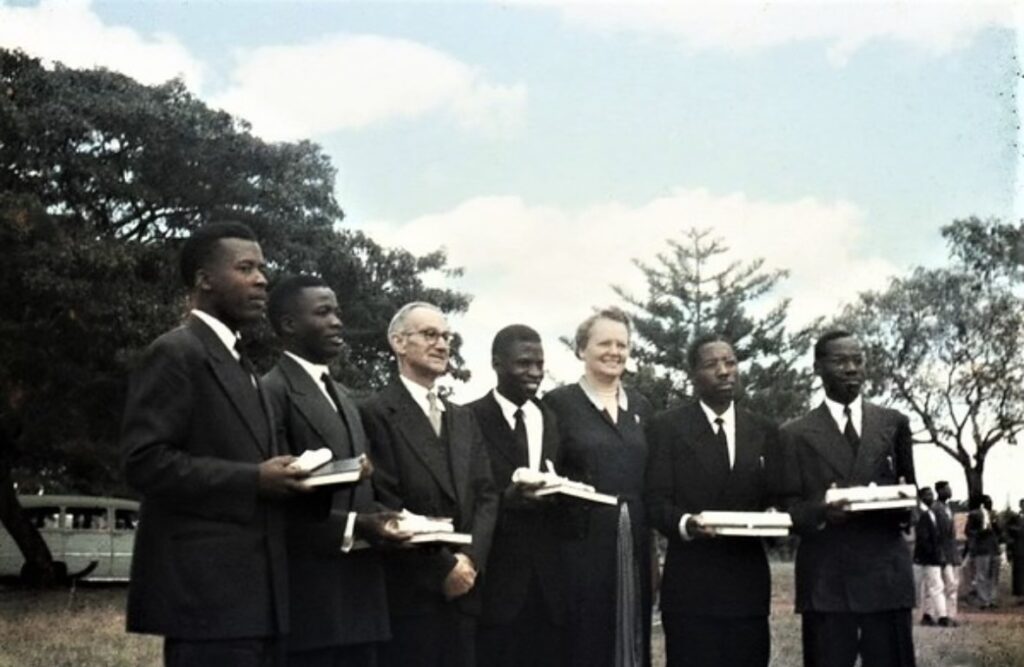
By the end of 1947 the family was back in Camundongo and soon after, Ralph and Jean were moved by the Angolan church to Dondi, to organize and direct the Emmanuel Theological Seminary – Séminario Emanuel. They used to joke that Ralph was the Principal and Jean the faculty, but they both taught full time for the remainder of their years in Angola. For some nine years, they were the entire full-time faculty of the seminary, and then one of their own graduates joined the faculty. By the later 50s the faculty had increased considerably. The seminary began with five students. In the early days, the students took their classes and lived in a building on the campus of Currie Institute, but soon a dormitory for the students was built just off the road to Lutamo. At first, classes were given in that dorm, but a third building, the actual seminary school – classrooms, library and chapel – was up and functioning well before Ralph and Jean retired to Canada in 1958.
At the seminary, Jean taught Old Testament courses including the Pentateuch and Minor Prophets, courses on the teachings of Jesus and the teachings of the Apostles, and some of the New Testament letters. She also had complete charge of the Christian Education Program, including courses for the wives of the students, and also led courses for ministers’ wives, who came in from their various districts. During the students’ third, final, year they were each required to write an autobiography, which they then read to the assembled congregation upon ordination. Jean spent endless hours editing these, of course in Umbundu, since few of them were natural writers and she really wanted a polished finished product. She and others were inspired by the stories told by these students. One had been sold into slavery as a child, and was later bought by his uncle, who then gave him his freedom; through this life experience, he deeply grasped the meaning of God’s gift of freedom and new life through Christ.
In addition to his administrative responsibilities, Ralph taught various courses required for ordination, including Homiletics. Ralph and Jean took the students on field trips to the villages, some of which had never heard the story of the Christian God. In one village, Ralph asked the chief: “Do you have a god?” “Yes, of course we have a god”, was the answer. “Do you know the nature of this god?” asked Ralph. “If we did, would we not be real men?” responded the chief. And Ralph and the seminary students began to teach them the Gospel story. Years later, one of the seminary graduates returned to that village as pastor and set up a church. Ralph and Jean also offered extension courses during the long dry season after the academic year closed.
Ralph and Jean not only taught, but formed a close community at the seminary, and their students gratefully remembered the parties at their house and the field trips as well as the formal classes.
Besides teacher, preacher and pastor, Ralph was also musician. Gifted with a beautiful tenor voice and a profound love and understanding of music, Ralph made an immeasurable contribution to the hymnody of the Umbundu church. He translated many hymns into Umbundu and wrote new ones with original tunes. He compiled a whole group of songs to be sung around the campfire. In the words of Rev. Theodore Tucker at Ralph’s funeral in Ottawa, “As musician Ralph spoke to the heart and soul of the Umbundu people. As singer he drew them heavenward; as choirmaster he raised the standard of singing of young and old, students, nurses, and village congregations; as poet and hymn writer he wedded good tunes and robust words and wrote many new hymns; as editor of the Umbundu hymnbook he improved the rhythm and language of many an old favourite; he supervised the production of the music edition of the Lira Evangelica. All the music plates had to be done by hand, with the help of some congregations in Ottawa, and Ralph watched over all the work till the final binding and distribution in Angola.”
Fluent in Umbundu and with a deep understanding of Umbundu culture, Ralph was also Bible translator, part of a team of many Angolan and missionary predecessors and colleagues. The translation was done over many years, in slow stages. With the support of the Bible Societies in Canada, Britain and the United States, the Bible was published in parallel Umbundu and Portuguese. When finally the book of Isaiah was translated into Umbundu and the passage (40:1) “Comfort, comfort my people says your God” was read from the pulpit of one church: “Lembi, lembi omanu vange, oco ca popia Suku yove”, the old elders in the front row sat with tears running down their cheeks, asking, “Why is it only now that we are hearing these words in our own language?” Ralph poured his heart and soul and energy into this translation work. Carrying the manuscript in their family trunks to the British and Foreign Bible Society on their way one year to furlough in Canada, Ralph commented, “In the hold of this ship is something far more precious than all the gold in the world.”
In the summer of 1958 Ralph and Jean returned to Canada for what turned out to be their final furlough and early retirement, as Ralph’s ill health prevented them from returning to Angola for a further term.
In spite of years of poor health, in his deep dedication to the church and people of Angola Ralph had pursued a full-time schedule that would have daunted many. In retirement in Canada, he continued to push himself, including as pulpit supply for months at a time in several consecutive churches in the Ottawa area, preaching elsewhere as invited, and writing and reading voluminously. With Jean, he taught at the Lay School of Theology, as it was called then, in Ottawa, a program of Ottawa Presbytery of the UCC providing theological education to lay Christians. He continued to support the work in Angola. One project he undertook was collecting pump organs to ship over to Angola for churches there; at times, the Collins house in Ottawa had several pump organs filling every space available until they could be shipped! In a further example of his concern for the people he loved, he helped promote further studies for a former student, Rev. João Kapuka, who had been forced into exile in Zambia because of the Angolan colonial regime.
While Ralph was still in Angola, his deep contribution to the life of the Angolan church was recognized by his alma mater, United Theological Seminary, McGill University, which wanted to confer on him the honorary degree of Doctor of Divinity (DD). Ralph refused it. The offer was made again; again Ralph refused. In the end, he gave in to the persuasion of others, including Rev. Dr. Jessie Arnup of the United Church of Canada Board of World Mission, and accepted the degree while still in Angola. From then on he was known formally as Rev. Dr. Ralph Collins. In September 1970, complications from his old ulcer and the surgery took him away from us.
In her later years of retirement, Jean too received the honorary degree of Doctor of Divinity from United Theological Seminary, McGill University, in May 1975, and gave the convocation address. From then on, she was affectionately known in many presbytery and other church circles as Dr. Jean.
A supremely gifted story-teller, preacher and public speaker, Jean continued through most of her retirement to meet requests to speak at church services and to Sunday Schools and mid-week church groups. During their furloughs and in her retirement, Jean had, in the end, spoken in every province across Canada.
Eleven years younger than Ralph and in robust good health, Jean was not ready to retire when they could not return to Angola. In 1959 she was accepted as part-time staff of the English Department of Carleton University in Ottawa, where she taught for seven years. When their mandatory retirement age did not allow her to continue on faculty, she then taught full time in the English Department of Algonquin College in Ottawa for four years.
Jean then resigned from Algonquin College in 1972 in order to make a four-month trip re-visiting Africa with a friend, spending time in Kenya, Zambia, South Africa, and then two months in her beloved Angola where, after 14 years’ absence, she was received with warm affection and was able to preach every Sunday to congregations of a thousand and more, and to take part in several retreats of Angolan church leaders. She had joyful reunions with some of her and Ralph’s former students, some of whom had just been released from five years in a Portuguese prison camp.
In 1974, accepting the nomination by two presbyteries in the then Montreal and Ottawa Conference, Jean was a candidate for Moderator of the 26th General Council of the United Church of Canada. Two other candidates were Rev. Harriett Christie and Rev. Wilbur Howard. Rev. Wilbur Howard was elected.
Jean continued to tirelessly and enthusiastically carry out a busy and varied schedule. She became very actively involved in the Angola Memorial Scholarship Fund (AMSF). She was an active member of Southminster United Church in Ottawa, leading a mission-study group of young adults, speaking to the Sunday School and mid-week groups, and serving on committees. She volunteered as a Bible study leader, including weekly sessions at a seniors’ centre in Ottawa, her gifted scholarship and teaching skills bringing the Bible alive for so many. She gave Bible study courses at Women’s Area Conferences (in P.E.I., Minaki, and Banff) and various UCW summer schools (in Saskatoon, and Montreal & Ottawa Conference). She was an active member of the Outreach and International Affairs Committee of Ottawa Presbytery, and of the same committee of Montreal & Ottawa Conference. Outside of church activities, for many years she was active on the Board of the YWCA in Ottawa, and in her later years she joined a ‘secular’ book club, wanting to broaden her scope.
Jean also travelled widely in her retirement – including to Israel, Egypt, Portugal, England. In her unquenchable thirst for knowledge and understanding, she studied about each country before she went, and later others, too, greatly benefitted from this as she accepted invitations from church and other groups to speak, with illustrating colour-slides, about her travel experiences. Looking at her life-span, it is interesting that she was born in the year of the first air flight, 1903, when the Wright brothers flew. And she was 24 years old when Lindberg flew the Atlantic alone, from the USA to France. But in later life she herself traveled in big, fast jets from Canada to many far-flung places on the globe. On their furloughs from Angola, Ralph and Jean always travelled only by ship, loving the sea and the slow pace of ships, but she later unhesitatingly enjoyed the high speed of air travel.
Jean continued to live alone in their house in Ottawa until, just before New Year’s Day of 1994, she suffered a massive stroke. She died three months later in March of 1994, a few weeks short of the age of 91.
Ralph and Jean Collins unstintingly gave their hearts and lives to the Angolan people and the Evangelical Congregational Church of Angola (IECA), and to the church in Canada. Their ashes lie side by side in Pinecrest Cemetery in Ottawa, far from Winterslow, Montreal, Camundongo and Dondi, and in permanent togetherness. Va puyuke ciwa – May they rest well.